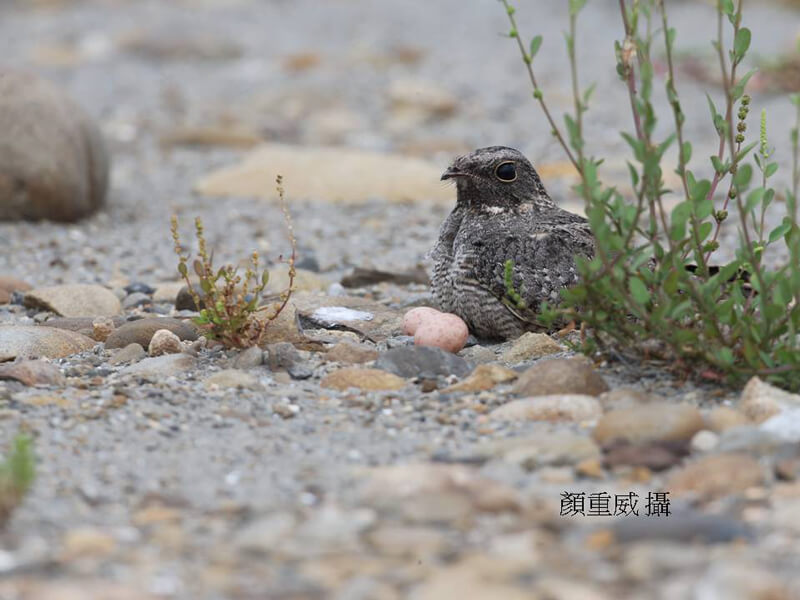
Savanna nightjar - Caprimulgus affinis Horsfield, 1821
Global distribution: India, Pakistan, Southeast Asia, southern China, Taiwan, the Philippines, islands of Indonesia.
Taiwan distribution: Widely distributed around Taiwan and offshore on Lanyu (Orchid Island).
Habitat and behavior: Mostly found along broad riverbeds with a mix of sandstone and other rocks in the middle to lower reaches of rivers, on exposed mud and rocks next to a river, on roads with little traffic, along airfields, in large industrial parks and on school campuses in areas with little human activity. In recent years, they have been able to adapt well to living in cities and towns and to perching and reproducing on building rooftops. During the day, this species stays on the ground or flat rocks. Its protective coloring conceals it from predators. It will only fly away if approached. It is most active at dawn, dusk and at night. It possesses short, weak feet, which makes it difficult to walk. It moves by flying straight upward.
Diet: Feeds on various types of flying insects, mostly of the orders Lepidoptera, Coleoptera, and Orthoptera.
First record in Taiwan: Swinhoe, R., 1863, Ibis 1863: 250-253.
Date discovered: October 10, 1861.
Location of first discovery: Tainan City.
Excerpt of summary of original text: Found in low-lying areas of Tainan on Formosa. It is a common summertime resident bird. I obtained two specimens, both female. In the spring, I observed many species of the family Caprimulgidae arriving in Tamsui. I believe they are of this species. During the day, they hid amid the shrubbery in hilly areas. Only if you were about to step on them would they fly away, startled.--From Development History of Birds in Taiwan by Lin Wen-Hong (1997), Taiwan Interminds Publishing.