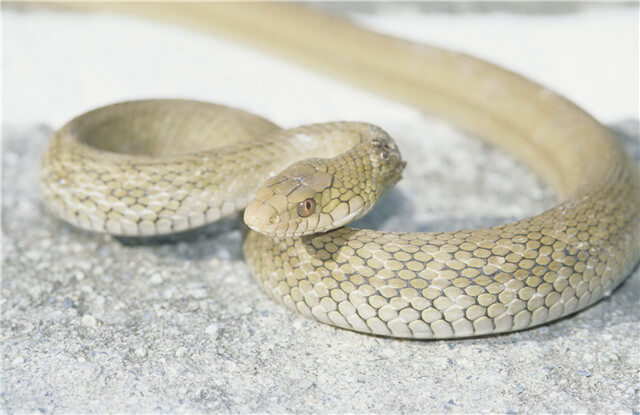
Elaphe carinata
Diet: The king ratsnake (Elaphe carinata) has a wide-ranging diet. It feeds on small mammals such as mice and birds, as well as on frogs. Except for a number of transient birds of prey, such as the crested serpent eagle, this snake does not have any natural predators on Lanyu (Orchid Island). However, as these snakes also prey on their own species, they have become their biggest natural enemy. They wrap themselves around their prey and asphyxiate it before swallowing it. They often make use of Taiwan kukri snakes to feed on green turtle eggs, as well as on Taiwan kukri snakes.
Characteristics: From the mouth to the eyes, the scales appear to form a pattern that resembles the Chinese character wang, which means king (王). This is where its name king ratsnake comes from. There are variations in coloring between juveniles and adults. In juveniles, the body is brown in color, while in adults it is ash gray with scattered white spots.
Habitat: These snakes are mainly found in forests, farmland and areas where sisal hemp is grown.
Movement: King ratsnakes are able to move quickly. Therefore, they are able to catch fast-moving prey such as skinks. The ventral scales are large, creating good traction. They have good climbing ability and can be seen on rock faces or high up in trees.
Reproduction: Eggs are laid during the summer (8-14 eggs). This species guards the nest.