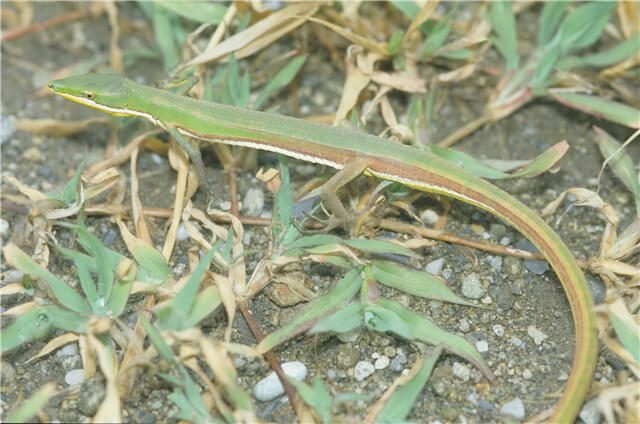
Sauter's grass lizard
Diet: The diet of Sauter's grass lizard (Takydromus sauteri) is highly unique and related to its habitat. It includes leaf hoppers, spiders, ants and snails. In the stomachs of these lizards have been found numerous plant seeds. It is not known if these are food or were swallowed to help grind and break up food.
Characteristics: There is little variation in their external appearance from the time that they hatch. The female is entirely green. The posterior part of the male is brown with a red line along the back and abdomen. Green is a protective color that helps to camouflage it in areas of silvergrass. This lizard species does not hibernate in winter and can be seen year round. It is more easily sighted on sunny days.
Habitat: Sauter's grass lizard prefers silvergrass clusters, from the lighthouse to the road that circles the island and towards Tianchi. The body is long and thin and the tail length is two to three times that of the body. It is highly adapted to moving through grass. Its natural enemies are snakes, which cannot climb grass. Therefore, they prefer this unique habitat for survival.
Movement: The tail of this lizard is an excellent balancing mechanism. In addition, with its light body weight it can move through areas of grass very quickly.
Reproduction: The reproductive season of this lizard species is from March to August. Two to three eggs are laid at one time and a female can lay eggs at least twice each year. It is possible to see males and females in courtship and mating during the reproductive season. The fat bodies of this lizard species are used for reproduction.