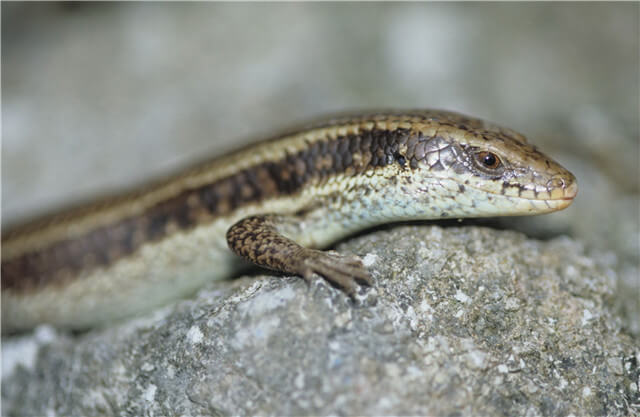
Mabuya longicaudata
Diet: The long-tailed sun skink (Mabuya longicaudata) has a very diverse diet including insects, such as crickets, cicadas, praying mantids, katydids, stinkbugs, scarab beetles, moth larvae, moth pupae, weevils, leafhoppers, Coleoptera beetles, tiger beetles, slant-faced grasshoppers, ants and locusts, as well as false scorpions and spiders. It also preys on geckos and feeds on the eggs of other small lizards such as the South China forest skink and the fruit of the two-flowered nightshade.
Characteristics: There is little variation in their external appearance from the time that they hatch. They are brown along the back with several bands of black dots. From the tip of the snout to the hind limbs is one thick black band. As Lanyu (Orchid Island) is located in tropical climate zone, temperatures remain fairly high in winter. Thus, this skink does not hibernate and can be seen year round. In winter, it is most often sighted on cement walls, as cement absorbs sunlight creating warmth. Thus, this is the most common habitat for this skink in the winter.
Habitat: The long-tailed sun skink has a broad distribution from the Central Cross-island Highway to the lighthouse and the road that circles the island. However, its distribution is also somewhat scattered. For example, along the Central Cross-island Highway, it is concentrated at the Hongtou Village terminus, as there are more dark and damp forested areas and food is more plentiful. It is rarely found at the intersection of the Central Cross-island Highway and the road that leads to the weather station. In contrast, there are more sightings of South China forest skink (Sphenomorphus incognitus). However, where the Central Cross-island Highway slopes downward toward Yieyin, there are larger numbers of this skink. This is also where they lay eggs and care for their young.
Movement: This is one of the largest skinks in Taiwan. The front and back limbs, as well as the tail, are strong and powerful. Therefore, they are able to move well and quickly. The distribution of this species is quite broad, including tropical forest, meadowland, farmland and beaches. They are especially easy to spot in areas of drainage ditches where leaves have piled up. This species has long and powerful claws. Thus, it is able to freely move along rock faces and cement walls, and even climb trees.
Reproduction: The reproductive season of the long-tailed sun skink is between February and August. Five to 13 eggs are laid at one time and a female can lay eggs at least twice each year. The female will care for the eggs until they hatch. Oligodon formosanus preys on the eggs of the long-tailed sun skink in holes in cement walls where they were laid. If there is no female guarding the eggs, they will quickly be eaten. There are often battles between this snake and female long-tailed sun skinks. Usually the long-tailed sun skink emerges the victor and the snake leaves. Almost all lizards store energy in fat bodies at the back of the abdominal cavity to be used during reproduction and care of the young. Following reproduction, this skink will eat large amounts to store up energy in preparation for the next reproductive season.