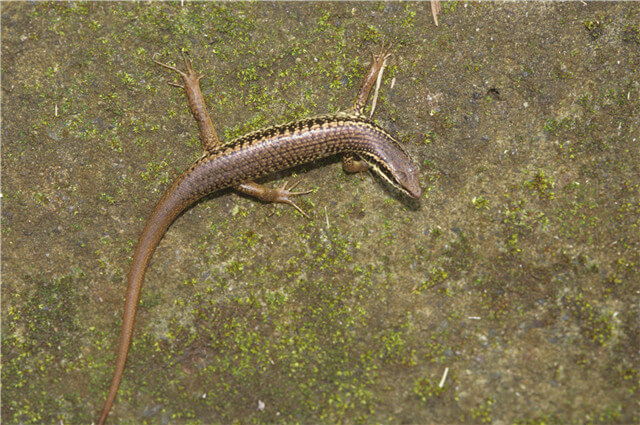
South China forest skink
Diet: The diet of the South China forest skink (Spehnomorphus incognitus) includes insects such as crickets, cicadas, cockroaches, katydids, stinkbugs, leafhoppers, ants and locusts, as well as some spiders. This species also preys on blind snakes. They tend to be active in areas where leaves have accumulated in drainage ditches. Due to the high nutrient content of rotting leaves, there are often large numbers of invertebrate animal species. Therefore, animals that feed on invertebrate animals are also attracted, such as blind snakes and the South China forest skink. That is why blind snakes join the list of animals eaten by this skink.
Characteristics: There is little variation in external appearance from juvenile to adult. These skinks are ash brown along the back. From the tip of the snout to the hind limbs, there is thick, dark, lengthwise band. On the inner sides of the hind limbs near the cloaca is a relatively large keeled scale. On Lanyu (Orchid Island), this species does not hibernate in winter and can be seen year round. In winter, it is most often seen on cement walls, as cement absorbs the sunlight creating warmth. Thus, this is the most common habitat for this skink in the winter.
Habitat: The South China forest skink has a broad distribution from the Central Cross-island Highway to the lighthouse and the road that circles the island. However, its distribution is somewhat scattered. For example, along the Central Cross-island Highway, it is concentrated at the Hongtou Village terminus, as there are more dark and damp forested areas and food is more plentiful. It is found in higher numbers at the intersection of the Central Cross-island Highway and the road that leads to the weather station, but in lower numbers where the Central Cross-island Highway slopes downward toward Yieyin. It is also active along beaches and in sisal hemp cultivation areas.
Movement: The South China forest skink is able to move quickly and well. The distribution of this species is quite broad, including tropical forest, farmland and beaches. It is especially easy to spot in drainage ditches where leaves have piled up. It also freely moves along rock faces and cement walls.
Reproduction: The reproductive season of the South China forest skink is between March and July. Three to seven eggs are laid at one time and a female can lay eggs at least twice each year. Oligodon formosanus preys on the eggs of the South China forest skink. As this skink does not have the ability to defend itself or its young against this snake, it does not lay its eggs in holes in cement walls. This skink does not have fat bodies. It stores up energy for reproductive use in the liver or tail. Following reproduction, this skink will eat large amounts to store up energy in preparation for the next reproductive season.