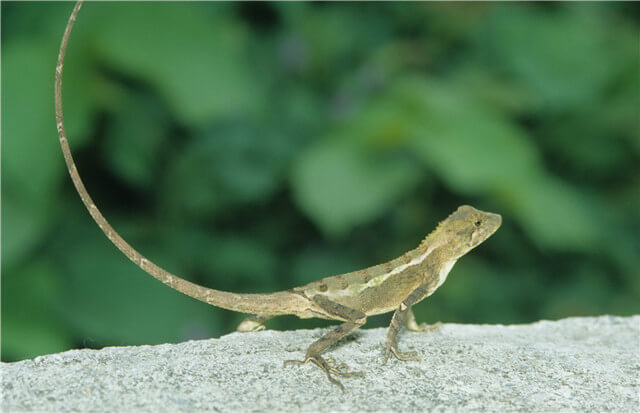
Swinhoe's tree lizard
Diet: Swinhoe's tree lizard (Japalura swinhonis) feeds on crickets, cicadas, katydids, bees, moth larvae, weevils, leaf hoppers, ants and spiders, etc.
Characteristics: The males possess a yellow band along the left and right sides of the back. The edges of the oral cavity are white and the throat has white spots. On Lanyu (Orchid Island), this lizard does not hibernate in winter, and can be seen year round. In winter, it is most often sighted on cement walls, as cement absorbs sunlight, creating warmth. Thus, this is the most common habitat for this lizard in the winter.
Habitat: This species of lizard has a broad distribution. It can be seen in almost any area where there are trees, from the Central Cross-island Highway to the lighthouse to the road that circles the island. It has also been recorded climbing silvergrass. At night, it stays in trees or areas of thick vegetation.
Movement: Japalura swinhonis is one of Taiwan's largest tree lizards. Its claws are extremely powerful. Thus, it can move freely along rock faces or cement walls. It is able to move quickly and well. The distribution of this species is quite broad, including tropical forest, meadowland, farmland and beaches. It is also be seen along roadways, feeding on insects such as ants. However, due to this it is often run over by vehicles and killed.
Reproduction: The reproductive season of this species is between March and September. Three to seven eggs are laid at one time and a female can lay eggs at least twice each year. After laying eggs, the female covers them in dirt or leaves. The size of each egg is approximately 12 x 7 millimeters. Males and females exhibit territorial behavior, including push-up displays and head nodding.