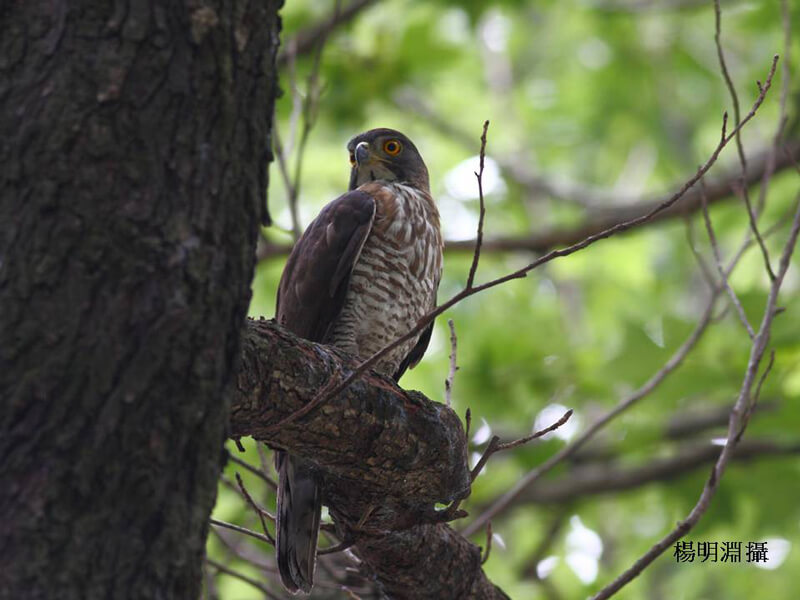
Crested goshawk - Accipiter trivirgatus (Temminck, 1824)
Global distribution: India, Indochina, Malaysian Peninsula, Sumatra, Java, Bali Island, Borneo, southern Philippines, southwestern China, Taiwan, and Hainan Island.
Taiwan distribution: Widely distributed in mountainous and hilly areas below 2000 meters. Only a small number of sightings have been made on Taiwan's offshore islands, such as Turtle Island. This species has also been sighted on the islands of Penghu.
Habitat and behavior: Mainly found in low- to mid-elevation forests or coastal forests. They are sometimes also found in manmade forests, fruit orchards, or parks with thick wooded areas or hunting for food in neighboring plains. This is a diurnal bird-of-prey. It mostly perches in trees. When the weather is warm and sunny, it prefers to take flight. It is strongly territorial. The males soar to a cruising altitude and then clearly show the white feathers under their tails and shake their wings to announce their territorial claim. They are very able to adapt to areas of human development and can live and reproduce year round in urban areas.
Diet: This species has a broad diet including rodents, squirrels, small- and medium-sized birds, lizards, frogs and cicadas. It has also been discovered capturing poultry and domesticated birds.
First record in Taiwan: Gurney, JH., 1865, Ibis 1865:547.
Date discovered: March 1865.
Location of first discovery: Inland, near Tamsui.
Excerpt of summary of original text: On page 366 of the 1863 Ibis journal, I wrote one short article on Accipiter virgatus (sparrow hawk) and Accipter gularis (Japanese sparrow hawk). At that time, I had not sighted an Accipter gularis. However, I received one pair by mail. They were Accipter gularis from Formosa. At the same time, there was one pair of Accipter virgatus. This confirmed that these species were both living on this island...On March 22, I submitted my report on the pair of Accipter gularis specimens I received from Formosa. From the male specimen, I was certain that this was Accipter gularis. Upon further examination of the female, I found that it was a juvenile Accipiter trivirgatus. It was completely consistent with a specimen of the same age obtained from India. In addition to correcting this error, I issued an apology to this journal's readers. This is the first record in my memory of Accipiter trivirgatus on Formosa.--From Development History of Birds in Taiwan by Lin Wen-Hong (1997), Taiwan Interminds Publishing.