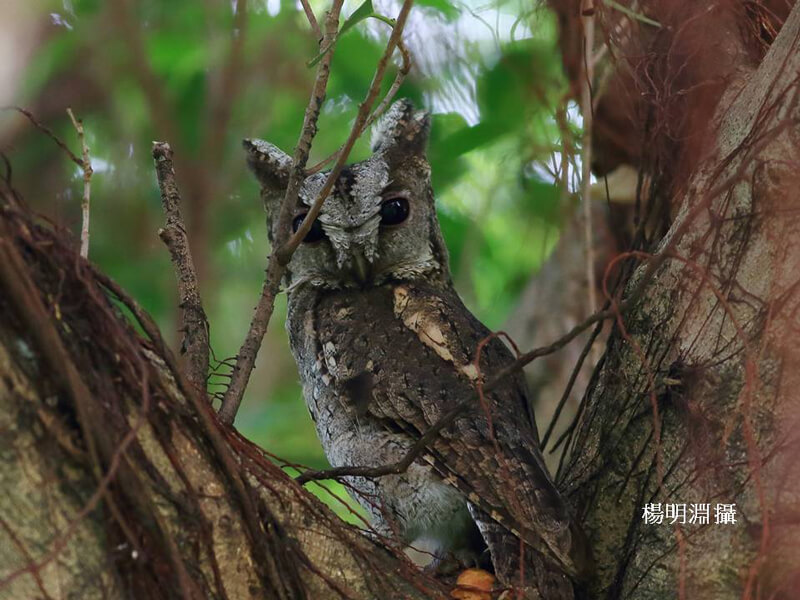
Indian scops owl - Otus bakkamoena Pennant, 1769
Global distribution: India, Southeast Asia, Northeast Asia.
Taiwan distribution: All over Taiwan in low elevation hills. Among the offshore islands, it has only been sighted on the islands of Penghu.
Habitat and behavior: Mainly found in woodlands in low elevation areas. This species adapts well to residual forest in areas of human development and is found in large cities, such as in parks where there are some trees. It has also been found on school campuses. The Indian scops owl is nocturnal. When hunting for food, it prefers to perch on the end of a protruding branch. Sometimes, it perches on buildings. Therefore, it is not difficult to observe. When startled, its body elongates, its ear tufts rise and its eyes widen. It remains completely still. It is often active along roadways in low mountain areas on the outskirts of cities and, thus, is sometimes struck and killed by vehicles.
Diet: Includes small and medium-sized birds, no larger than the red turtle dove, insects (of the orders Blattodea, Orthoptera and Mantodea, etc.), frogs, rodents and lizards.
First record in Taiwan: Swinhoe, R.,1863, Ibis 1863: 217-218.
Date discovered: April 1, 1862.
Location of first discovery: Most likely inland in Tamsui.
Excerpt of summary of original text: On April 1, someone brought me a complete female specimen from the inland hills. This is the only specimen I have obtained on Formosa. This species is also found in Fuzhou. I have obtained many specimens from there. Once, as I was traveling along the way to Tamsui, in the fading light of dusk I observed one bird of this species flying from a pine tree to the rooftop of a home where it perched. Its body became elongated and it began to call. On a quiet, dark night, this bird's call can be quite jarring. It is easy for those who are superstitious to consider it a bad omen and to be afraid it will come near their homes. The local people associate it with unclean animals, shamanism and healing. This owl is used to treat many types of illnesses and thus is sold at high prices. Doctors often recommend making a soup from it for those with lung diseases or tuberculosis and for treating rhinitis in the elderly.--From Development History of Birds in Taiwan by Lin Wen-Hong (1997), Taiwan Interminds Publishing.