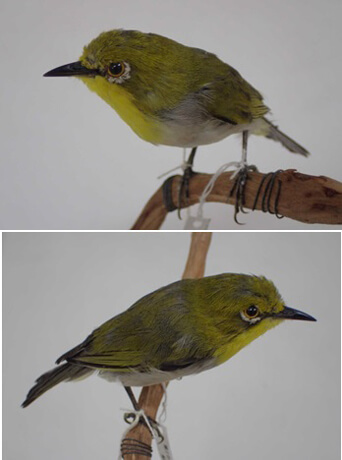
Zosterops japonicus simplex (Swinhoe, 1861)
The fire-breasted flowerpecker, plain flowerpecker, and warbling white-eye are all birds that feed on nectar and, by doing so, assist in the pollination of plants. However, the Japanese white-eye has not developed the ability to quickly digest and absorb the polysaccharides that coat the seeds of mistletoes. In addition, its digestive system has retained its normal grinding function, which can damage the ingested seeds. Therefore, it is not as effective as flowerpeckers at disseminating mistletoe seeds.
The warbling white-eye is a small passerine (order Passeriformes) in the family Zosteropidae with many common names in the Chinese-speaking world. It has an average lifespan of 15 years. Based on new classification methods, it is possible that it will be renamed Swinhoe’s white-eye. If interested, you can follow the research progress. This bird has a body length of around 11 cm. Its dorsal surface is roughly yellowish-green and it has obvious white circles around its eyes and a black band in front of each eye. The forehead is slightly yellow. From the throat to the upper chest, it is yellow, while the lower chest and abdomen are off white, and the flanks are grayer. The lower tail coverts are yellow. The irises are red. The beak is black and the legs are lead gray.