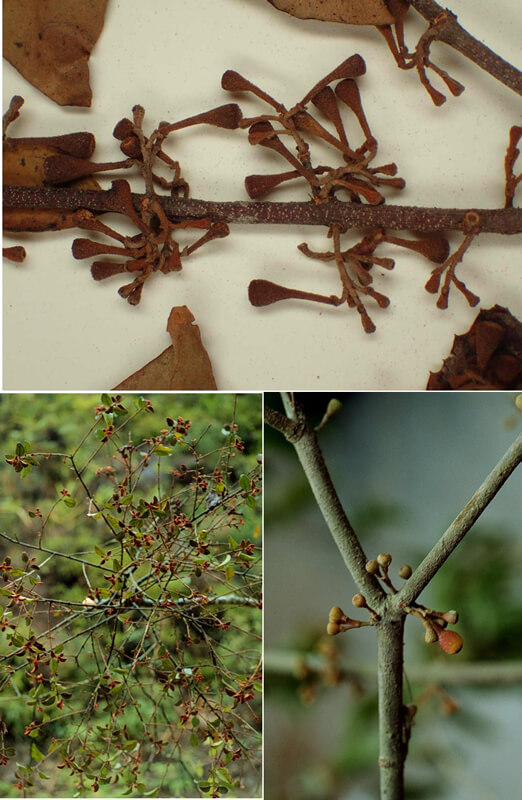
Scurrula parasitica L.
Loranthus, the representative genus of the Loranthaceae family, was first described by Carl Linnaeus in 1753. Since not many scholars understand the characteristics of mistletoes, there has been some naming confusion, with some genus and species names used interchangeably. It was difficult to deduce the nomenclature rules. Therefore, international nomenclature rules were adopted in 1964. The type specimen for the yellow-berried mistletoe (Loranthus europaeus), published as Loranthus Jacq. (1762), is the representative of the genus Loranthus, distinguishing it from the genus Scurrula.
The type specimen representative of the genus Scurrula is Scurrula parasitica Linnaeus, Sp. Pl. 1: 110, published by Linnaeus in 1753. It was collected in southern China and its main characteristic is that its fruit is shaped like a Western pear and not an Asian pear (which is apple shaped). It is most easily confused with the genus Taxillus (Taxillus Tieghem, Bull. Soc. Bot. France. 42: 256. 1895). The fruit and area of connection with the stem are round and blunt, which is more like the shape of an Asian pear, and not the pyramid shape of a Western pear. With the adoption of the 1964 nomenclature rules, many mistletoe species were renamed based on their morphology to make their classification consistent with natural phylogenetic relationships.