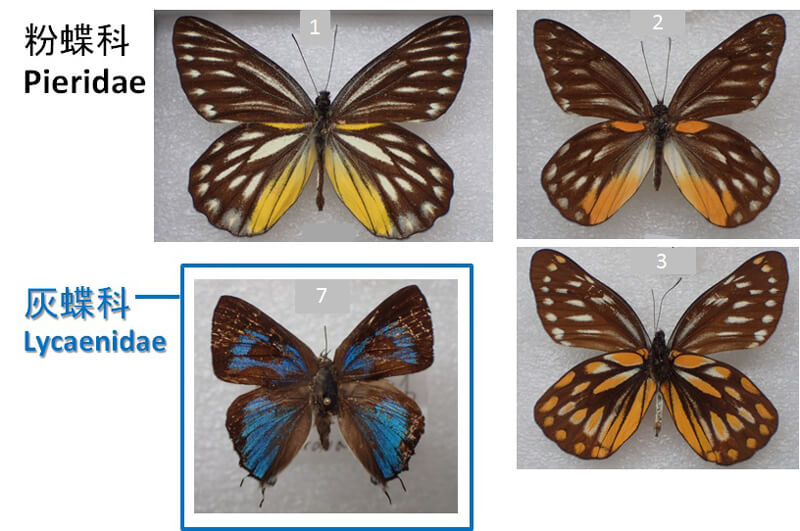
Family Pieridae (1-3), family Lycaenidae (7)
The leaves of the mistletoes Viscum alniformosanae Hayata/ Viscum articulatum Burm. are food sources.
1. Broadwing Jezebel/male ( Delias lativitta formosana Matsumura, 1909)
2-3. Dark Jezebel/2. Dorsal view/3. Ventral view (Delias berinda wilemani Jordan, 1925)
7. Bi-spot royal/male (Ancema ctesia cakravasti (Fruhstorfer, 1909))
1. Delias lativitta formosana Matsumura, 1909 is known as the broadwing Jezebel. The female lays eggs on the host plant. The eggs are yellow and cone-shaped with fine longitudinal ridges along the glossy surface. The larvae of this species collectively feed on the young leaves of Viscum alniformosanae Hayata and Viscum articulatum Burm. f. in the Loranthaceae family. Larvae have a black head and greenish-brown body. Along the body are white spots and long white hairs. The mature larvae pupate on a twig of the host plant or between a twig and leaf of a nearby plant. The pupae are dark brown with a horn-like protrusion in front and two pairs of lateral centrally located cone-shaped dorsal protrusions.
2-3. Delias berinda wilemani Jordan, 1925 is a butterfly known as the dark Jezebel and is endemic to Taiwan. Females lay eggs on the leaves of the host plant. The eggs are yellow and cone-shaped with fine longitudinal ridges along the glossy surface. The larvae collectively feed on the young leaves of host plants, such as large-leaved Loranthus (Loranthus delavayi Van Tiegh), Taxillus lonicerifolius (Hayata) Chiu, and hairyleaf Taxillus (Taxillus rhododendricolius (Hayata) S. T. Chiu). The larvae have a black head and yellowish-green body with bumps and white hairs along the surface. The mature larvae pupate on a twig of the host plant or between a twig and leaf of a nearby plant. The pupae are dark brown with a curved protrusion in front. In the middle of the back is a pair of outward curving horn-like protrusions.
7. The male bi-spot royal (Ancema ctesia cakravasti (Fruhstorfer, 1909)) (family Lycaenidae) has a wingspan of 28-34 mm. Among males, the surface of the wings is blue with wide black edges. In the center is a large black spot. The wings of females are lighter with no black spot in the center. The undersides of the wings appear similar in males and females, ash white with black dotted bands. Among males these markings are larger and among females these markings are smaller. At the tips of the wings are two orange markings inlaid with black. Among females the wings are wider. This genus has one species and in Taiwan it is considered an endemic subspecies. It is distributed in hilly and mountainous areas at 500-2,000 meters in elevation. The larval host is Viscum articulatum Burm. f. in the family Loranthaceae. The adults can fly quickly and males visit wetlands to obtain water. This species can produce multiple generations in a year.