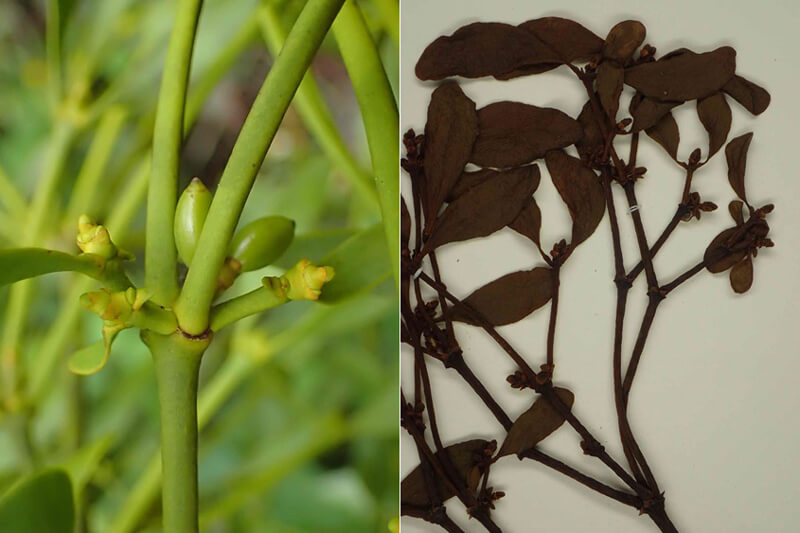
Viscum alniformosanae Hayata
Plants of the genus Viscum are small parasitic evergreen shrubs that grow on the branches of a host tree, invading it with a single haustorium.
Viscum alniformosanae Hayata has cyclindrical, bifurcated, yellowish-green, and smooth branches. Some species also have leaves, which are opposite, and grow at the tips of the branches. In addition, they are leathery, thick, and oblong or oblanceolate, with 3-5 straight veins. The photosynthetic structures may not be fully functional. Flowers are unisexual, dioecious, and borne on branch tips or at bifurcations. In addition, they are yellowish-green, with four stamens and no filaments. The ovary is inferior, one-celled, without styles. The stigma is capitate. The berries are spherical and measure 0.5-0.6 cm in diameter. They are orange-yellow to red when ripe. The mesocarp is fleshy and sticky. They are found on trees in mid-elevation areas along Taiwan’s Central Mountain Range, commonly on Formosan alder trees in round colorful clusters. The ripe fruits attract flowerpeckers.