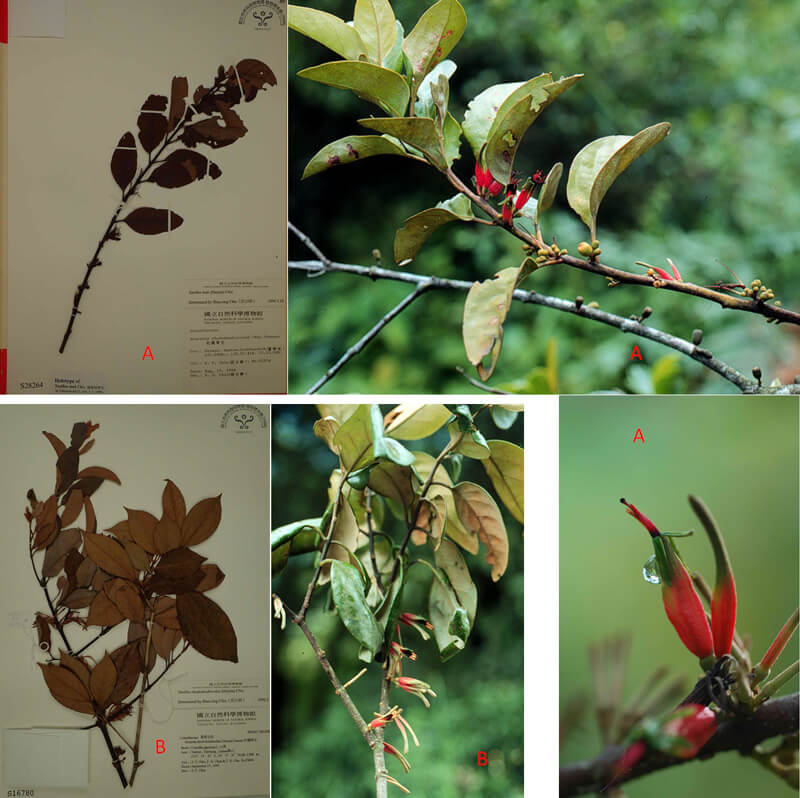
Lianhuachi mistletoe Taxillus tsaii Chiu and Hairyleaf Taxillus Taxillus rhododendricolus (Hayata) Chiu
Lianhuachi mistletoe (Taxillus tsaii Chiu) is a parasitic shrub that can reach 50 cm in height and possesses many branches. The branchlets are cylindrical, with scattered lenticels. The young twigs and leaves are often covered in light yellow or brown stellate trichomes. However, these are lost over time. The leaves are leathery or papery with glossy green surface and scattered light yellow stellate trichomes. The dorsal surface is covered in brown trichomes. As the leaves age, these trichomes become sparser and the surface becomes smoother, resulting in a trichome density gradient on the dorsal surface. At the midrib, the surface is slightly concave and the dorsal surface is significantly raised. There are 4-5 lateral veins and they are more prominent on the dorsal surface. The flower bracts are oval, 0.1 cm long and wide. The exterior is covered in brown trichomes and the apex margin is hairy. The calyx is ovate, 0.2-0.25 cm long, often with four serrated clefts at the apex.
In comparison, the leaves of hairyleaf Taxillus (Taxillus rhododendricolus (Hayata) Chiu) are leathery, ovate-oblong, with large size variation, 4.5-5 cm long, 2-2.5 cm wide, with blunt apex, and rounded base. The upper surface is covered in downy hairs and the lower surface in brown or red downy hairs. The hairs are few and gradually become sparse. The flower bracts are thick, triangular, and covered in downy hairs. The calyx tube is covered in downy hairs. The curator compared the records of mistletoes in Taiwan during the Japanese colonial era (1895-1945) with specimens from the family Loranthaceae in China. In 1996, a new plant species was published with the name “tsaii,” referring to the surname Tsai to commemorate Dr. Tsai Su-Hwa, who was a professor in the Department of Botany at National Taiwan University and an authority on plant anatomy in Taiwan. The common name Lianhuachi mistletoe is to commemorate the collection of the type specimen in Lianhuachi.